Product

One Platform. Every Stage of the Fiber Lifecycle.

Everything your team needs to design, document, build, and operate fiber networks — in one workspace.

BG Image
The Lux workspace — the live map and the agent terminal
BG Image
The Lux workspace — the live map and the agent terminal

Lux aOS™

The agentic operating system for fiber work

Book a demo →

Frontier Models

The right model for each task — deep reasoning for design, fast models in the field, a fine-tuned specialist for splicing. The better the models get, the more the aOS does.

Agentic Harness

Orchestration, adversarial verification, and a reactive spine that keeps every artifact consistent. Autonomy is earned per toggle, with measured success rates.

Data & Integrations

A versioned datastore under everything. The network, devices, payments, ERP and CRM flow in through four lanes — real systems, never mocks.

Context & Knowledge

The ontology: your network modeled to the fibre strand — templates, rate cards, constraints. The operator’s collective expertise, layered into every agent action.

Fiber Capabilities

Design, splice, permits, certification, provisioning, assurance, billing. Deterministic engines that draw, price, gate and correlate — agents decide, engines execute.

Products & Interfaces

Eighteen desks over one map — workspaces for every role, the field in their pocket, customers on their own portal.

Security & Governance

Roles, agent capability walls, approval trails, SSO. A machine never files, pays, digs or promises alone. Built into every layer, not bolted on.

Solution

Agents Draft. Engineers Decide.

The Lux workspace

Complete Network Designs in Minutes

Optimized GIS network design for the area you select, to your rules — splice plans, BoM, BoQ and work orders included.

BG Image

This Week - Dispatching

Phase 1 dispatch

Input: This week’s splices

Assign crews by drive time

Push work orders to phones

Check as-builts on arrival

Flag variance to engineering

Progress

0%

0%

BG Image

This Week - Dispatching

Phase 1 dispatch

Input: This week’s splices

Assign crews by drive time

Push work orders to phones

Check as-builts on arrival

Flag variance to engineering

Progress

0%

0%

The Field Runs on the Same Model

Crews get work orders and splice instructions on their phones. As-builts come back through the app, checked by AI against the design as they land.

BG Image

Network Overview

Live

Network map

Synced

As-built record

On plan

This week

Field activity — last 12 hours

Splicing

on schedule

Design Agent

on schedule

Inspections

all passed

BG Image

Network Overview

Live

Network map

Synced

As-built record

On plan

This week

Field activity — last 12 hours

Splicing

on schedule

Design Agent

on schedule

Inspections

all passed

See Everything. Ask Anything.

A live map of the network and every crew on it — message any worker or their agent, and get executive answers straight from the data.

BG Image
Card Image
BG Image
Card Image

Fits the Systems You Already Run

Standard formats in and out — shapefiles, GeoJSON, DXF, Excel — and your own engineering rules and catalogue drive every design.

Your Organization as Code

Your Organization as Code

People, crews, trucks, spools — one typed model of the whole operation, versioned like code and readable by the agent.

Org Chart
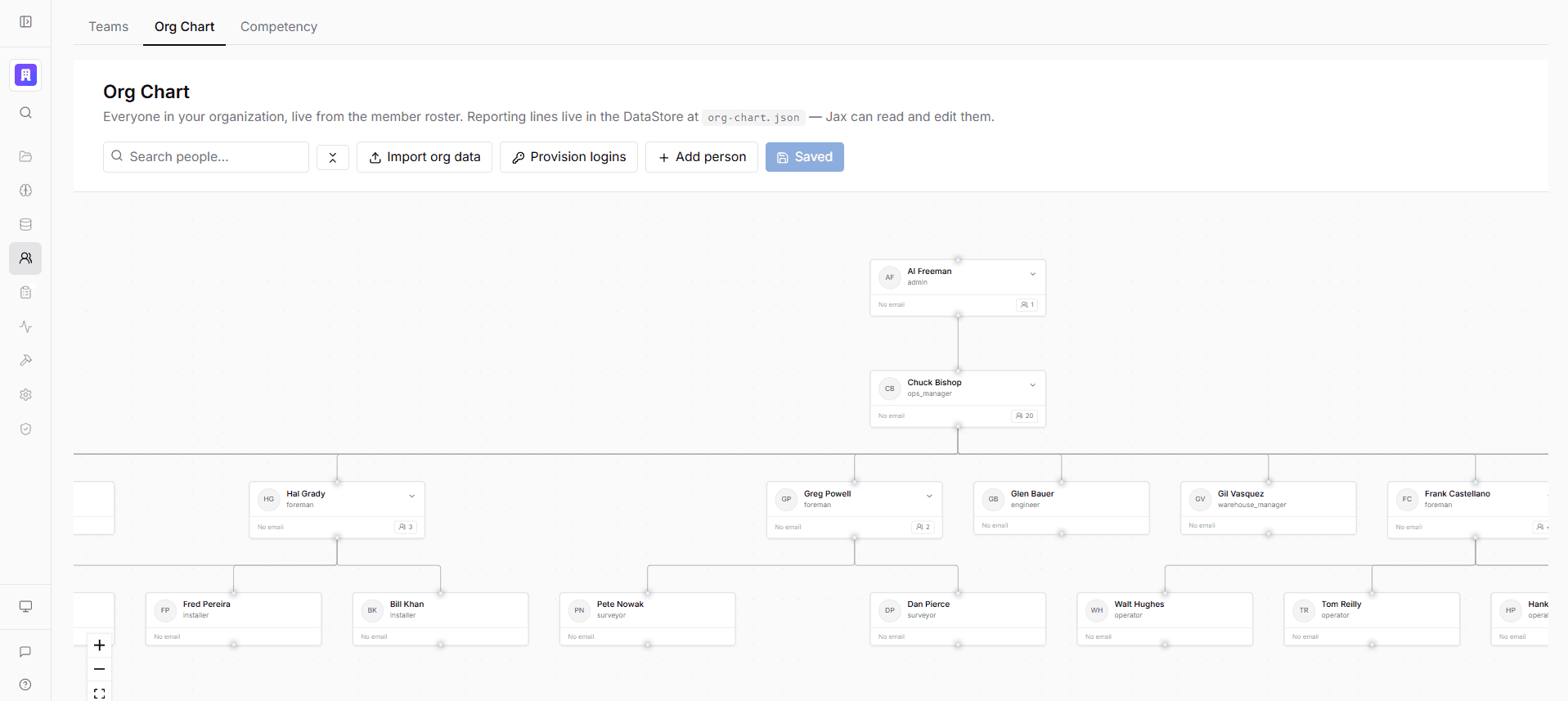
Org chart, live from the member roster

Everyone in your organization, live from the roster — reporting lines are a file the agent can read and edit.

Brain

The organization graph with an answer about a splicer

Ask anything about anyone and anything that happened — the answer comes with the receipts.

image

Workflow Canvas

Webhook Trigger

AI Agent

Send Response

Agent Overview

Live

342

Tasks Today

99%

Success Rate

Running Agents

Sales Intelligence Agent

342 tasks

Content Classifier

219 tasks

Data Pipeline v2

88 tasks

Learning new insight

How It Works

From Setup to Launch in Three Simple Steps

Connect your data

01

Bring your GIS, your rate cards and your standards. Shapefiles, GeoJSON, DXF and Excel in — nothing to rebuild.

Set your rules

02

Your engineering standards, your materials catalogue, your approval thresholds. Lux designs to them, not to a generic template.

Go live with your team

03

Desks for every role, the field app in your crews’ pockets, and agents that draft while your engineers decide.

image

Workflow Canvas

Webhook Trigger

AI Agent

Send Response

Agent Overview

Live

342

Tasks Today

99%

Success Rate

Running Agents

Sales Intelligence Agent

342 tasks

Content Classifier

219 tasks

Data Pipeline v2

88 tasks

Learning new insight

How It Works

From Setup to Launch in Three Simple Steps

Connect your data

01

Bring your GIS, your rate cards and your standards. Shapefiles, GeoJSON, DXF and Excel in — nothing to rebuild.

Set your rules

02

Your engineering standards, your materials catalogue, your approval thresholds. Lux designs to them, not to a generic template.

Go live with your team

03

Desks for every role, the field app in your crews’ pockets, and agents that draft while your engineers decide.

image

Workflow Canvas

Webhook Trigger

AI Agent

Send Response

Agent Overview

Live

342

Tasks Today

99%

Success Rate

Running Agents

Sales Intelligence Agent

342 tasks

Content Classifier

219 tasks

Data Pipeline v2

88 tasks

Learning new insight

How It Works

From Setup to Launch in Three Simple Steps

Connect your data

01

Bring your GIS, your rate cards and your standards. Shapefiles, GeoJSON, DXF and Excel in — nothing to rebuild.

Set your rules

02

Your engineering standards, your materials catalogue, your approval thresholds. Lux designs to them, not to a generic template.

Go live with your team

03

Desks for every role, the field app in your crews’ pockets, and agents that draft while your engineers decide.

FAQs

Have questions?

Find answers.

Have more questions?

Reach out to our friendly support team

What does Lux actually produce?

Complete network designs — routes, equipment placement, fiber allocation — plus the documents that follow from them: splice diagrams, bills of materials, permit-ready drawings, and work orders.

What inputs does it need?

A serving area. Lux imports GIS layers, CAD files, and spreadsheets, and can work from public geodata where your records are thin. The more you give it, the sharper the result.

Does it work with our existing GIS?

Yes. Standard formats in and out — shapefiles, GeoJSON, DXF, and Excel — so designs and documentation flow into the systems your teams already run.

How accurate are the designs?

Geometry, routing, and optimization run on deterministic engines, validated against your engineering rules. Your engineers review and approve everything before it is released to the field.

Who reviews the output?

You do. Lux drafts; your engineers approve. Every artifact is traceable to the design decision behind it, so review is fast and auditable.

How do we get started?

Book a demo and bring a serving area — we will design it live in the session. Or skip the call: one area, designed and priced in 48 hours.

FAQs

Have questions?

Find answers.

Have more questions?

Reach out to our friendly support team

What does Lux actually produce?

Complete network designs — routes, equipment placement, fiber allocation — plus the documents that follow from them: splice diagrams, bills of materials, permit-ready drawings, and work orders.

What inputs does it need?

A serving area. Lux imports GIS layers, CAD files, and spreadsheets, and can work from public geodata where your records are thin. The more you give it, the sharper the result.

Does it work with our existing GIS?

Yes. Standard formats in and out — shapefiles, GeoJSON, DXF, and Excel — so designs and documentation flow into the systems your teams already run.

How accurate are the designs?

Geometry, routing, and optimization run on deterministic engines, validated against your engineering rules. Your engineers review and approve everything before it is released to the field.

Who reviews the output?

You do. Lux drafts; your engineers approve. Every artifact is traceable to the design decision behind it, so review is fast and auditable.

How do we get started?

Book a demo and bring a serving area — we will design it live in the session. Or skip the call: one area, designed and priced in 48 hours.

FAQs

Have questions?

Find answers.

Have more questions?

Reach out to our friendly support team

What does Lux actually produce?

Complete network designs — routes, equipment placement, fiber allocation — plus the documents that follow from them: splice diagrams, bills of materials, permit-ready drawings, and work orders.

What inputs does it need?

A serving area. Lux imports GIS layers, CAD files, and spreadsheets, and can work from public geodata where your records are thin. The more you give it, the sharper the result.

Does it work with our existing GIS?

Yes. Standard formats in and out — shapefiles, GeoJSON, DXF, and Excel — so designs and documentation flow into the systems your teams already run.

How accurate are the designs?

Geometry, routing, and optimization run on deterministic engines, validated against your engineering rules. Your engineers review and approve everything before it is released to the field.

Who reviews the output?

You do. Lux drafts; your engineers approve. Every artifact is traceable to the design decision behind it, so review is fast and auditable.

How do we get started?

Book a demo and bring a serving area — we will design it live in the session. Or skip the call: one area, designed and priced in 48 hours.